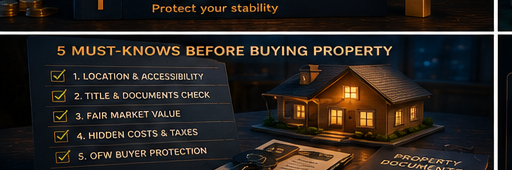
Buying property is one of the most common goals among OFWs. It is tangible, it is meaningful, and it represents something real to come home to. But property purchases gone wrong are also one of the most common financial disasters in OFW stories — and they tend to be large, irreversible, and expensive to correct.
This list is not meant to discourage anyone from buying property. It is meant to make sure that when you buy, you buy with full information. Property laws, tax rates, and developer regulations in the Philippines can change; always verify current rules with a licensed real estate broker or a lawyer before signing anything.
1. Verify the title before anything else
The most fundamental step in any Philippine property transaction is confirming the title is clean and authentic. For a house and lot, the document is a Transfer Certificate of Title (TCT). For a condominium unit, it is a Condominium Certificate of Title (CCT). These documents are issued and recorded by the Register of Deeds.
Before agreeing to any purchase, go to the Register of Deeds that has jurisdiction over the property and request a Certified True Copy of the title. This copy will show you whether the title is free of encumbrances (mortgages, liens, or claims from other parties), whether the registered owner is actually the person selling to you, and whether there are any annotations that should concern you.
This step is non-negotiable. A seller showing you a photocopy of a title proves nothing. Only the Register of Deeds can confirm what is actually recorded. If you are abroad and cannot do this yourself, authorize a trusted person through a Special Power of Attorney (SPA) to verify on your behalf — or hire a lawyer to do it. Do not pay any reservation fee or down payment before this verification is complete.
2. Research the developer thoroughly before pre-selling
Pre-selling properties — units or lots sold before construction is complete — are widely marketed to OFWs because the payment terms are spread out and the entry price is lower. The risk is that you are buying something that does not yet exist, based on a developer’s promise.
Before committing to a pre-selling project, research the developer’s history. Look at projects they have already completed: were they delivered on time, did the finished product match what was promised, and are there buyer complaints on record? Check whether the developer is registered with the Housing and Land Use Regulatory Board (HLURB, now DHSUD — the Department of Human Settlements and Urban Development). A legitimate developer should have a license to sell and the project should have a registration certificate. Verify this directly with DHSUD.
Developer reputation matters more in pre-selling than in any other property transaction, because once you have signed a contract and started paying, your leverage to demand delivery is limited.
3. Do not buy property you have not seen in person
This may be the most important caution on this list, and it is the one most commonly ignored by OFWs. Photos can be taken from flattering angles. Rendered images of pre-selling projects look nothing like the eventual reality. Surrounding areas — flooding, noise, proximity to industrial zones, poor road access — do not appear in a developer’s marketing materials.
Before committing to a property purchase of any size, visit it in person. Walk the neighborhood. Arrive during rain if you can, to check for flooding. Talk to people who live nearby. If you genuinely cannot visit because of your work contract, postpone the decision until you can — or accept that you are buying with a significant blind spot that may be costly to discover later.
If a property is priced and marketed in a way that creates urgency (“reservation only good for this weekend”), treat that urgency as a warning sign rather than a reason to act faster.
4. Have a clear management plan for while you are abroad
Buying property as an OFW means owning an asset you cannot personally manage. If it is a rental property, someone needs to find and screen tenants, collect rent, coordinate repairs, and handle problems. If it is a home you are building, someone needs to supervise construction, manage the contractor, and verify that materials and work quality match what was agreed.
Who is that person? What is their authority, and what are the limits of that authority? If it is a family member, is there a written agreement about what they will and will not do? If it is a professional property manager, what are their fees and what does the contract cover?
OFWs who buy property without answering these questions often return home to find unfinished construction, unpaid rental collections, or property being used without permission. The asset is only as good as the management structure behind it.
5. Calculate the real total cost, not just the selling price
The price listed on a property advertisement is not the amount you will pay to complete the transaction. Closing costs in the Philippines are borne differently by buyer and seller depending on what has been negotiated, but as a buyer you should typically budget for:
- Documentary Stamp Tax (DST): as of recent years, approximately 1.5% of the selling price or zonal value, whichever is higher
- Transfer Tax: varies by locality, typically 0.5% to 0.75%
- Registration Fee: varies, based on a schedule from the Registry of Deeds
- Notarial/legal fees
- Capital Gains Tax (if applicable — typically borne by the seller, but sometimes passed to the buyer in negotiation)
Total closing costs often add up to 5% to 8% on top of the selling price. On a property worth 2 million pesos, that is 100,000 to 160,000 pesos in additional costs that you need to have ready at the time of transfer. If you have not planned for this, the transaction may stall at the most inconvenient moment.
Tax rates and fees are subject to revision under local ordinances and national law. Verify current rates with the Bureau of Internal Revenue (BIR), your local government unit, and a licensed broker or lawyer before signing any documents.
Property can be a sound investment and a meaningful goal — but it is also one of the most complex financial transactions most people will ever make. Do the verification. Take the time to see it. And never sign under pressure.
(Property laws, tax rates, and regulatory requirements change. Always consult a licensed real estate broker (PRC-licensed), a lawyer, or both before completing any property transaction.)