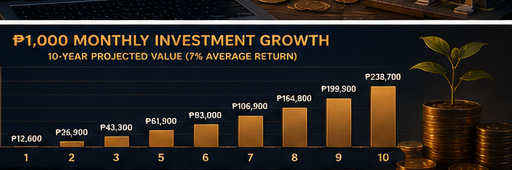
One of the most common reasons Filipinos give for not investing is that the amount they have available is too small to matter. P1,000 a month feels like a number that belongs in a piggy bank, not a brokerage account. But the math says otherwise — and more importantly, the habit of investing P1,000 consistently is the same habit that eventually handles P5,000 and P10,000. The amount you start with matters far less than the act of starting. Here are five places P1,000 a month can realistically go in the Philippines today.
1. MP2 — Pag-IBIG Fund’s Modified Pag-IBIG 2
MP2 is a voluntary savings program offered by Pag-IBIG Fund that consistently offers higher dividends than a standard savings account, with the backing of the Philippine government. For employed members, the minimum monthly contribution is P200. For voluntary members — which includes self-employed individuals and OFWs — the minimum is P500 per month. The program has a five-year maturity, after which you can withdraw your full savings plus dividends, or opt for another five-year cycle.
Historical MP2 dividend rates have ranged from approximately 6% to 8% annually over recent years, though these rates are declared by Pag-IBIG at the end of each year and are not guaranteed in advance. (As of 2026, verify current dividend rates and contribution minimums at pagibigfund.gov.ph.) MP2 is not a liquid investment — you commit for five years — but for medium-term savings at a low risk level, it remains one of the strongest options available to Filipinos.
2. High-yield digital bank savings — GSave, Maya, CIMB, Seabank, Tonik
This is worth including honestly: digital bank savings accounts are not investments. They are savings with a better interest rate than traditional banks. A standard savings account in a major Philippine bank offers roughly 0.10% to 0.25% per year. As of 2026, digital banks like GCash GSave, Maya Savings, CIMB, Seabank, and Tonik have offered rates ranging from approximately 4% to 6% annually — though rates change frequently; verify current offers directly at each platform.
If your P1,000 per month is building up toward an emergency fund or a short-term goal within one to two years, a digital bank account is a reasonable place for it. It’s liquid, PDIC-insured up to P500,000 (pdic.gov.ph), and earns meaningfully more than traditional savings. The limitation is that these rates, however high now, are not locked in and tend to decline over time as competitive pressure adjusts.
3. GInvest — UITFs through GCash
GInvest is GCash’s built-in investment feature that allows you to invest in UITFs (Unit Investment Trust Funds) with lower minimum amounts than walking into a bank and opening a fund directly. Available fund types include money market funds (very low risk, typically yielding just above inflation), balanced funds (mix of fixed income and equities), and equity funds (higher risk, higher potential return over long periods).
For a P1,000 monthly investor, a money market or balanced UITF through GInvest is a practical starting point. The money market option functions similarly to a high-yield savings account but with the structure of a pooled investment fund. The balanced or equity options expose you to the stock market in a managed way, without requiring you to research individual stocks. (As of 2026, verify available funds, fees, and minimum amounts at gcash.com/ginvest or within the GCash app.)
4. T-bills via BDO Kabayan, GInvest, or online platforms
Treasury Bills (T-bills) are short-term debt instruments issued by the Philippine national government, typically with terms of 91, 182, or 364 days. Because they are government-issued, they carry essentially zero default risk. T-bill yields have ranged from approximately 5% to 7% in recent years depending on term and market conditions — verify current auction rates at treasury.gov.ph or through your platform.
T-bills are traditionally purchased in large minimum amounts, but platforms like BDO Kabayan Securities and GInvest have made them accessible with lower entry points. If you’re willing to lock in your P1,000 for 91 to 364 days at a competitive rate and want a government-backed vehicle, T-bills are a straightforward option. The limitation is that unlike savings accounts, T-bills are not liquid before maturity.
5. FMETF via a stockbroker
The First Metro Philippine Equity Exchange Traded Fund (FMETF) is a single stock listed on the Philippine Stock Exchange that tracks the PSEi — the main index of the 30 largest publicly listed companies in the Philippines. Buying one share of FMETF is, in effect, buying a proportional stake in all 30 PSEi companies at once. This is what diversification at low cost looks like for a stock market beginner.
FMETF trades like a regular stock, so you need a brokerage account — COL Financial, First Metro Securities, or BDO Securities are common entry points. The price per share fluctuates with the PSEi; as of 2026, it has traded in a range that makes one to a few shares accessible at P1,000. There are brokerage commissions per transaction, so the strategy of buying once or twice a month is more cost-efficient than daily small purchases. (Verify current FMETF price and broker commission rates at pse.com.ph or your chosen broker’s platform.)
These are estimates using compound growth models, not guarantees. Actual returns depend on the instrument, dividends declared, and market conditions.
- At 5% average annual return: approximately P155,000 to P158,000 total value after 10 years
- At 6% average annual return: approximately P163,000 to P168,000 total value after 10 years
- At 8% average annual return: approximately P180,000 to P185,000 total value after 10 years
Starting principal: P120,000 (P1,000 x 12 months x 10 years). The returns above represent roughly P35,000 to P65,000 in growth on top of your own contributions, depending on the instrument.
These numbers are not meant to impress. They are meant to show that P1,000 a month is not too small to matter — it is small enough to start.
The amount you start with is not the point. The habit you build with it is.