More Filipinos are investing than at any point in recent memory. The rise of investment apps, government-backed programs like MP2, and accessible stock trading platforms has made starting easier than ever. That is largely a good thing.
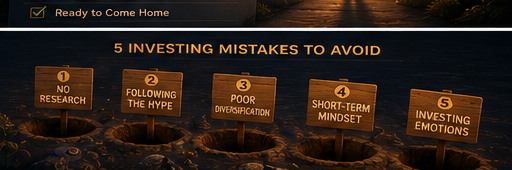
But easier entry also means more people are investing before they fully understand what they are doing, or before their financial situation is actually ready for it. The five mistakes below are common, correctable, and worth understanding before you put your first peso anywhere.
Important note: all investments carry risk. Past performance does not guarantee future returns. Nothing in this post is financial advice. It is a starting point for doing your own research.
1. Investing while carrying high-interest debt
This is the most common and most costly mistake for beginners in the Philippines. The reasoning behind it sounds sensible: start investing now, even a little, so you build the habit. The problem is the math.
If you have a credit card balance charging 2% to 3% per month (which translates to roughly 24% to 36% per year), and you are investing in something that historically returns 6% to 12% per year, you are losing ground on the net. Your investment gains do not cover what your debt is costing you. Paying down that high-interest debt first is, in effect, a guaranteed return equal to the interest rate you eliminate.
The correct sequence is: settle high-interest consumer debt first, build a basic emergency fund second, then invest. This is not exciting. It is correct.
The exception is employer-matched contributions to a retirement fund, where the match itself is an immediate return. That is worth continuing regardless. But discretionary investing while high-interest debt is compounding is working against yourself.
2. Putting everything into one investment
Beginners often go all-in on one thing: all in MP2, all in one stock, all in one cryptocurrency, all in one mutual fund. It feels simpler and the returns seem better when one option has been performing well recently.
Diversification is not about reducing your potential gain. It is about reducing the impact of one thing going badly. Every investment carries its own set of risks. Government-backed programs like MP2 carry lower risk but are not zero-risk. Individual stocks carry company-specific risk alongside market risk. Digital assets carry high volatility and regulatory uncertainty.
A simple starting approach for most Filipino beginners is to spread across at least two or three different types: for example, a portion in a government program like MP2 or Treasury Bills (T-Bills), a portion in a balanced or equity UITF or mutual fund, and keeping your emergency fund in a high-yield savings account entirely separate. As of 2026, verify current T-Bill rates and UITF performance at the Bureau of the Treasury (treasury.gov.ph) and each fund’s official disclosures.
3. Chasing high returns without understanding the risk
“12% a month guaranteed” and “double your money in 6 months” are, in the Philippines, reliably the language of scams. But this mistake goes beyond obviously fraudulent offers. It also includes legitimate higher-risk investments that beginners enter without understanding what “higher risk” actually means in practice.
Individual stocks can lose 30%, 50%, or more in a downturn. Some UITFs have negative returns in certain years. Real estate is illiquid and carries its own carrying costs. Cryptocurrency is highly volatile and largely unprotected by Philippine financial regulations as of 2026.
Before investing in anything, the right questions are: what is the realistic range of outcomes, including the worst case? How long can I leave this money invested? If this investment lost 30% of its value this year, what would that actually mean for my financial situation? If you cannot answer those questions comfortably, do more research before committing.
4. Treating investment apps as savings accounts
Several popular investment apps in the Philippines blend the visual language of savings apps with investment products. A money market fund looks like a savings account. The balance shows up similarly. Withdrawals usually take one to three business days. This design is intentional and useful — but it creates a specific mistake for beginners.
Investment accounts, even lower-risk ones like money market funds, are not savings accounts. They are not covered by the Philippine Deposit Insurance Corporation (PDIC). Their values can fluctuate. They are not designed for short-term goals or emergency funds.
The correct approach: keep your emergency fund in a regular savings account at a PDIC-insured bank, where it is protected up to PHP 500,000 per depositor per bank (verify current PDIC coverage limits at pdic.gov.ph). Keep your investment accounts separate for money you will not need for at least one to three years, depending on the type of investment.
5. Stopping contributions when the market goes down
This is the mistake that erases the gains of the previous years of patience. The market drops, your UITF balance looks lower than what you put in, and the instinct is to stop contributing or to withdraw before it falls further.
The investors who build wealth over time do the opposite. When prices are down, each contribution buys more units of the same fund. When the market recovers, those cheaper units appreciate. This is not a theory. It is how cost-averaging works in practice.
The people who lose money in long-term investments are most often the ones who stop when the market falls and restart when the market has already recovered — buying high, selling low, the opposite of what they intended.
The correct response to a market downturn, for a long-term investor with a diversified portfolio, is usually to continue contributing at your normal pace and review your strategy only if your personal circumstances have actually changed.
Investing is worth learning and worth starting. The mistakes above are not reasons to avoid it. They are the list of things worth understanding before you do.