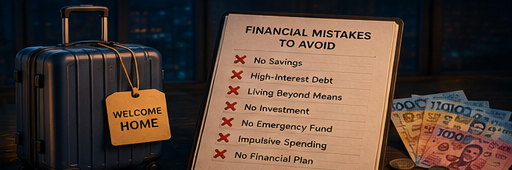
Going home after years abroad is supposed to be the reward. And in many ways it is — the reunions, the familiar food, the morning routines with people you love. But the financial adjustment after returning is harder than most OFWs expect, and harder than most people around them acknowledge.
The mistakes on this list are not signs of carelessness. They come from years of carrying a family, from emotional exhaustion, from the very natural desire to finally stop being careful for one moment. They are easy to make. They show up in the first six to twelve months after return, and their effects can stretch for years.
This is not a list to make you feel bad if you recognize yourself. It is a list to help you prepare before you land.
1. Going Home With No Income Plan
The most common and most consequential mistake. After years of a stable foreign salary, returning to the Philippines without a specific, running income source is a financial cliff. The monthly send stops. The household expenses continue. Savings start depleting from day one.
An income plan is not “I’m thinking of starting a business.” It is a specific business or income stream already operating or already contracted before the flight home. The setup work — registering a business, building a client base for freelance work, preparing a rental unit, investing in income-generating assets — needs to happen before the return, not after.
OFWs who return with no income plan often return abroad within a year, sometimes taking on debt to cover the next deployment cost.
2. Spending Big on Celebrations and Renovations Immediately
The pressure to celebrate is real. You have been away for years. Your family waited. The instinct to spend generously on a homecoming, a renovation, a new appliance, a gathering — these are not wrong impulses.
The timing is the problem. In the first months after return, income is usually at its lowest since you left. Your buffer fund is actively being used. Spending significantly on celebrations or renovations at the same time depletes the exact resource you need to survive the transition period.
This is not about refusing to celebrate. It is about staging the spending. A modest homecoming is not a lesser homecoming. The renovations can wait six months. Your buffer fund cannot be rebuilt quickly once it is gone.
3. Stopping Investments and Contributions Too Early
Some OFWs stop SSS voluntary contributions, Pag-IBIG contributions, or ongoing investments as soon as they return — partly to conserve cash, partly because these things feel like “abroad expenses.” But contributions and investments stopped during the transition period are contributions and investments that do not compound.
The gap in SSS contributions, for example, can affect your eventual benefit computations. MP2 accounts that are stopped prematurely may still earn the dividend for the period invested, but the compounding is interrupted. For investments in UITFs or stocks, selling at return time — often at a lower valuation during a transition period when markets may be uncertain — can lock in losses.
The goal is to maintain what is already running for as long as possible. Adjust amounts if needed, but stopping entirely has costs that are not always visible immediately.
4. Underestimating Monthly Expenses in the Philippines
Many OFWs carry a version of the Philippines in their memory from when they left. The cost of rice, electricity, gasoline, groceries, children’s school fees, medicine — all of these have changed, often significantly, over the years abroad.
Before going home, get an honest, current estimate of monthly household expenses — not from memory and not from what family says, but from an actual itemized monthly budget based on current prices. Ask your spouse or a sibling to track expenses for one month and send you the numbers.
The gap between what OFWs expect and what they discover in the first month home can be jarring. Going home with that gap already closed, in your budget at least, removes one significant source of stress from the transition.
5. Having No Health Insurance After Losing Employer Coverage
Employer-provided health coverage typically ends on the last working day. This is a moment most OFWs know is coming but do not fully prepare for.
PhilHealth is a baseline. Voluntary contributions as a returning OFW or an employed local worker can continue coverage. But PhilHealth does not cover everything — co-payments, non-benefit procedures, and gaps in coverage mean that a single serious illness or hospitalization can cost significantly more than PhilHealth reimburses.
Private health insurance for a person in their 40s in the Philippines is not cheap, but it is less expensive than an uninsured hospitalization. Research coverage options before leaving abroad — premiums may be higher if you wait until after you have returned and any pre-existing conditions are already documented.
6. Giving Too Much to Extended Family During the Adjustment Period
The request patterns often do not change after you return. Family members who received monthly support while you were abroad may expect that support to continue, or may increase requests because you are now present and “have more time to handle things.”
The first year home is not the year to expand financial support to extended family. It is the year to build stability for your immediate household. This requires direct, honest conversations that most Filipino families find difficult — conversations about what changed financially when you came home, and what you can and cannot continue.
This is one of the most emotionally difficult parts of the return. It is not about being less generous. It is about being honest about the actual numbers, and protecting the stability that allows you to stay home.
7. Not Having Enough Buffer Months
Six months of expenses is a starting point. In practice, many returning OFWs find that income stabilization takes longer than expected: a business takes longer to generate profit, a local job search extends beyond the projected timeline, a planned income stream encounters unexpected delays.
OFWs who return with four months of buffer instead of six, or six months instead of twelve, find themselves making difficult decisions much earlier than they should — going back abroad, taking on debt, or selling assets at unfavorable times.
The buffer is not the money you plan to spend. It is the money you hope not to spend. Add more to it before you go home than you think you need.
8. Going Home for Emotional Reasons Before Financial Readiness
This is the one nobody says out loud. Years of separation, missing milestones, worry about aging parents, homesickness that compounds — these are real and valid. They are also not financial reasons.
Going home because you cannot stand being away anymore is understandable. It is human. But if the financial foundation is not in place, the emotional relief of returning is often followed by financial anxiety that creates a different, sustained kind of stress — one that strains exactly the relationships you came home to protect.
There is no easy answer here. Sometimes the emotional cost of staying longer is real and should be weighed. But it should be a conscious decision, not an assumption that everything will work out. If you are going home before the financial foundation is solid, go in with clear eyes: know which gaps exist, have a specific plan for each, and build as much buffer as possible before the flight.
These mistakes are not failures of character. They are failures of information, timing, and planning — things that can be corrected before they happen.
The OFWs who stay home after returning are usually not the ones who had the most money. They are the ones who knew what they were walking into.