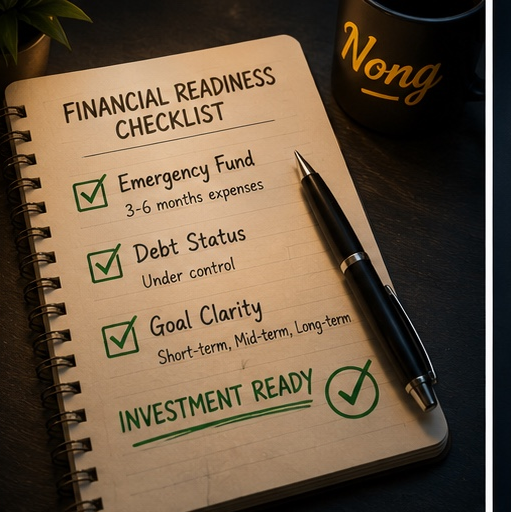
There’s a version of financial advice that tells you to start investing as early as possible, as soon as you have anything left over. That advice is not wrong in principle, but it skips an important step. Investing before you’re in the right financial position doesn’t build wealth — it often just moves money from a bad place to a riskier one. These five signs are concrete markers, not vague encouragement. They’re the conditions that make investing work rather than just feel productive.
1. Your high-interest debt is cleared.
This is the most overlooked prerequisite. If you’re carrying credit card debt at 36% interest per year, or a personal loan at 20-25%, or informal debt at any rate above that, the math is direct: paying off that debt gives you a guaranteed return equal to the interest rate. No investment in the Philippines — not MP2, not stocks, not UITFs — reliably returns 36% per year. Every peso that goes toward a high-interest balance instead of an investment is, in practice, earning a better return than almost any investment you could make. Clearing high-interest debt first is not a sacrifice of investment opportunity. It is the investment.
The caveat: not all debt disqualifies you from investing. A housing loan at 6-7% interest, or an SSS or Pag-IBIG contribution, sits at a different calculation. The rule of thumb is that debt above 10-12% annual interest should be cleared before investment capital is deployed elsewhere.
2. You have 3 to 6 months of expenses in an emergency fund — untouched.
An emergency fund is not an investment. Its job is to be boring and available. Three to six months of your household’s basic expenses — rent or mortgage, food, utilities, transportation, and any medical baseline — sitting in a liquid account you do not touch unless something breaks. The reason this must come before investing is straightforward: if an emergency hits while your money is invested in a UITF or stock, you may be forced to sell at a loss to access cash. An emergency fund is what allows you to let investments do their job across time without being disrupted by life.
For savings accounts in the Philippines, consider digital banks (GCash GSave, Maya, CIMB, Tonik, Seabank) that currently offer higher interest rates than traditional savings. As of 2026, some offer 4-6% per year — verify current rates at each institution’s website, as rates change. This is not investing, but it is better than leaving emergency funds in a 0.25% passbook account.
3. You have stable monthly income and you know your actual surplus.
Not an estimate. The actual number, tracked. After income, fixed obligations, variable expenses, and remittances if applicable — what is consistently left over? Investing works when you are putting in a defined, repeatable amount. It breaks down when the “investment capital” is the same money that pays next month’s rent when your budget runs short. If you don’t know your real monthly surplus — not what you think it is, but what the numbers show — that work comes first. A simple monthly budget tracked for two to three months will give you this number with reasonable accuracy.
4. You understand at least one investment instrument before putting money into it.
You don’t need to understand everything before starting. But you need to understand the specific thing you’re putting money into: how it earns, what the fees are, what happens in a bad year, and how to get your money out. An MP2 account earns dividends declared by Pag-IBIG annually, has a five-year term, and is government-backed. A money market UITF invests in short-term government securities, is low-risk, and can typically be redeemed within a few days. An index fund tracks the PSEi and rises and falls with the Philippine stock market. If you can explain an instrument in plain language to someone else, you’re ready to invest in it. If you can’t, you’re not there yet — and that’s not a judgment, it’s just a step that hasn’t been done.
5. You can leave the money invested for at least three years without needing it.
Time is what makes investing work. Almost every legitimate investment instrument goes through periods of lower value — UITFs during interest rate cycles, stocks during market downturns, REITs when rates rise. Investors who are forced to withdraw during a dip lock in their losses. Investors who can leave the money alone recover, and over longer periods, tend to grow. The three-year minimum is a starting threshold, not a ceiling. For equity-heavy investments like stock funds or REITs, five to ten years is a more realistic frame. If there is a meaningful chance you will need the money within two years — a planned expense, a family obligation, a loan payment — that money should be in a savings or time deposit, not an investment account.
Most of us are working toward this list, not across from it. But now at least the target is visible.