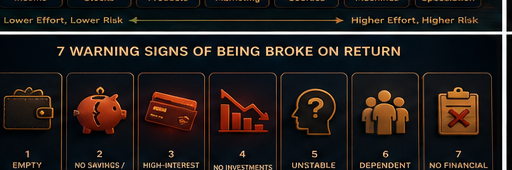
You have seen it. Maybe in your own family. A relative who worked abroad for years — sometimes decades — and came home with almost nothing to show for it. This is not a story about bad luck or laziness. It is a story about patterns. And because these patterns are predictable, they are also avoidable.
This post is written from a place of understanding, not judgment. Some of these patterns I have seen up close. Some I have lived parts of myself. The goal is not to shame anyone — it is to name what is happening clearly enough that someone can recognize it in time to change course.
1. Remittance habit without a savings habit
The financial identity of most OFWs is built around sending money home. The salary arrives, the remittance goes out, and what is left — if anything — goes to living expenses abroad. There is no structure that routes a portion of income into personal savings before the remittance is sent.
After years of this pattern, the OFW has successfully funded everything for the family at home: the house, the education, the daily expenses. But their own savings account is nearly empty, because the remittance was always the priority and their savings were always “what was left.”
The counter: decide on a personal savings amount first — before calculating the remittance. Even a small fixed percentage, saved consistently, compounds into a meaningful amount over years. The remittance is an obligation; your own future is also an obligation.
2. Lifestyle inflation at home funded by remittances
When an OFW earns in a stronger currency, the family at home adjusts to that income. The house gets renovated. A car is purchased. Monthly expenses grow. Younger siblings or relatives come to depend on allowances. Slowly, the monthly remittance required to maintain the family’s lifestyle increases — and the OFW has no control over it because they are not present to see it happening in real time.
By the time the OFW is ready to come home, the family’s monthly expenses are structured around a level of remittance income that will disappear when the OFW stops working abroad. Nobody planned for this transition. The result is financial shock for everyone.
The counter: keep family expenses at a level the household can eventually sustain without OFW income. Deliberately avoid structuring the family’s lifestyle around a foreign salary. This is a difficult conversation to have with family, but not having it is more costly.
3. No investment while abroad
Working abroad and spending everything on remittances and daily living means no capital is building. No MP2 balance. No time deposits. No property equity. No stocks. After ten years of hard work, the only financial product is a nearly empty savings account.
Investing while abroad is not complicated to begin. Pag-IBIG MP2 can be set up and funded online. T-bills can be purchased through the Bureau of the Treasury’s online platform. The barrier is usually not access — it is the habit of treating investment as something to think about later.
The counter: start investing the same month you start working abroad. Even small amounts. The habit matters more than the amount in the early years.
4. Family financial dependence that was never addressed
Some OFWs support family members who are capable of earning but have not been required to because the remittance has always covered what they need. This is one of the most painful patterns to name because it involves people who are genuinely loved. But enabling long-term dependence is not the same as providing genuine support.
When the OFW comes home and the remittance stops, the family members who were never required to build their own income are suddenly unable to function independently. The pressure falls back on the returning OFW to continue providing — often at a time when they have no income themselves.
The counter: begin transitioning family members toward financial independence years before the planned return. Have honest conversations about what support will look like after you come home. Set timelines. These conversations are uncomfortable, but so is coming home to a situation you cannot financially support.
5. Coming home without an income plan
Going abroad was a decision backed by a contract, a job offer, and a clear income structure. Coming home is often the opposite: a vague intention to “figure it out” after arrival. The OFW returns, savings are limited, and months pass without income while they search for work, evaluate business ideas, or wait for something to materialize.
Each month without income is a month of spending down whatever savings exist. If savings are limited to begin with, the runway is short, and the pressure is immediate.
The counter: plan your return income before you return. This might mean a job application process started months in advance, a business plan developed while still abroad, or a clear timeline for a freelance service you can offer using skills from your overseas work. Uncertainty on return is normal; having no plan is avoidable.
6. A medical emergency that wiped out savings
Illness does not give advance notice. An OFW who spent years building modest savings can have that entire amount erased by a single hospitalization — for themselves or for a family member at home. Without health insurance that covers the specific scenario (some PhilHealth benefits for OFWs have limitations; verify your coverage), out-of-pocket medical costs can be catastrophic.
This is not a failure of financial planning so much as a gap in insurance coverage. But the practical outcome — returning home with no savings because of a medical event — is real and common.
The counter: maintain PhilHealth contributions throughout your time abroad and understand what your coverage actually includes. Consider private health insurance for both yourself and for dependents at home whose hospitalization you would fund. Think of insurance as the protection that keeps a medical emergency from becoming a financial one.
7. Investing in the wrong things
Some OFWs do save. They accumulate real money over years of disciplined work. And then they invest it in something that does not work: a business venture run by a relative with no business experience, a piece of property that was never transferred properly, or an investment scheme promising unrealistic returns that turned out to be a scam.
This is the most difficult to write about because the loss is not just financial — it is the loss of years of sacrifice. The money represented real time abroad, away from family, in difficult conditions.
The counter: apply the same skepticism to investments that you apply to everything else you spend real money on. Any investment promising guaranteed high returns without clear explanation of how those returns are generated should be verified with the SEC. Any business involving family money should have a written agreement and a real business plan. Any property purchase requires title verification (see L29). The size of the potential gain is not protection against the risk of loss — in many cases, it is the lure that creates it.
None of these seven reasons are inevitable. Each one has a specific counter, and most of those counters involve decisions that can be made today, regardless of where you are in your OFW journey. Coming home with something to show for years of sacrifice is possible. But it requires treating your own financial future with the same seriousness you give to the remittance every month.